
The Enterprise AI Misconception
Artificial Intelligence has become a strategic priority for organizations worldwide, making Enterprise AI one of the most important drivers of digital transformation. According to Gartner, worldwide AI spending is expected to reach $2.59 trillion in 2026, reflecting the growing commitment of enterprises to AI-driven innovation. However, increased investment alone does not guarantee measurable business value.
One of the most common misconceptions is that Enterprise AI success depends primarily on selecting the most advanced AI model. In reality, the model is only one part of the equation. The true foundation of Enterprise AI lies in the quality, accessibility, and governance of enterprise data.
Many organizations continue to operate with information distributed across ERP, CRM, HR, finance, and document management systems. While these platforms support individual business functions, they often remain disconnected, preventing AI from accessing the complete business context needed to generate accurate and reliable insights.
Gartner also notes that, despite the rapid growth in AI spending, many organizations continue to prioritize tactical AI initiatives over broader enterprise transformation, making it difficult for CIOs to demonstrate clear business outcomes from AI investments.
Successful Enterprise AI is therefore not defined by the size of the model, but by the strength of the data foundation behind it. Organizations that integrate, govern, and manage their enterprise data effectively are better positioned to scale AI, improve decision-making, and achieve sustainable business value.
Why Data Integration Has Become the New Competitive Advantage
As organizations accelerate their AI adoption, competitive advantage is no longer determined solely by the sophistication of AI models. Increasingly, it depends on how effectively organizations can connect, manage, and activate their enterprise data.
Modern enterprises generate data across ERP, CRM, HR, finance, customer service, and countless other business applications. Without integration, these systems operate in isolation, creating fragmented information that limits visibility, slows decision-making, and reduces the effectiveness of AI initiatives.
Recognizing this shift, Gartner identifies data integration as a fundamental capability for supporting operational, analytical, and AI use cases. Rather than treating integration as a technical back-office function, organizations are adopting it as a strategic business capability that enables trusted, AI-ready data across the enterprise.
An effective data integration strategy provides AI with a unified and consistent view of business operations. Instead of relying on incomplete or disconnected datasets, AI systems can access reliable information across departments, resulting in more accurate insights, stronger automation, and better business decisions.
This shift is also changing investment priorities. Gartner emphasizes that improving data integration maturity helps organizations reduce AI-related data costs while increasing the business value generated from AI initiatives.
In the era of Enterprise AI, data integration is no longer just an IT project—it is a strategic capability that transforms enterprise data into a sustainable competitive advantage.
The Hidden Cost of Fragmented Enterprise Data
Fragmented enterprise data is more than an operational inconvenience—it is a significant barrier to digital transformation and AI success. When critical business information is distributed across disconnected systems, organizations struggle to establish a consistent and reliable view of their operations.
The impact extends beyond IT departments. Business leaders often spend valuable time reconciling conflicting reports, employees duplicate work across multiple applications, and AI systems operate with incomplete or outdated information. These challenges reduce operational efficiency and weaken confidence in data-driven decision-making.
According to IBM, poor data quality costs organizations an average of $12.9 million annually, highlighting the financial consequences of inconsistent and fragmented information. As AI becomes more deeply integrated into enterprise operations, the quality and accessibility of data have become essential for generating accurate insights and delivering measurable business value.
Research from McKinsey & Company also emphasizes that organizations achieving the greatest returns from AI are those that combine AI adoption with strong data management capabilities and enterprise-wide integration, rather than focusing solely on AI models.
Addressing data fragmentation requires more than consolidating systems. It involves creating a connected data ecosystem where information is standardized, governed, and accessible across the organization. With a trusted data foundation, enterprises can improve decision-making, accelerate automation, strengthen compliance, and unlock the full potential of Enterprise AI.
Building an Enterprise AI Foundation
Successful Enterprise AI begins long before deploying AI models. It starts with building a reliable data foundation that enables AI to access accurate, secure, and well-governed information across the organization. Without this foundation, even the most advanced AI technologies struggle to deliver consistent business value.
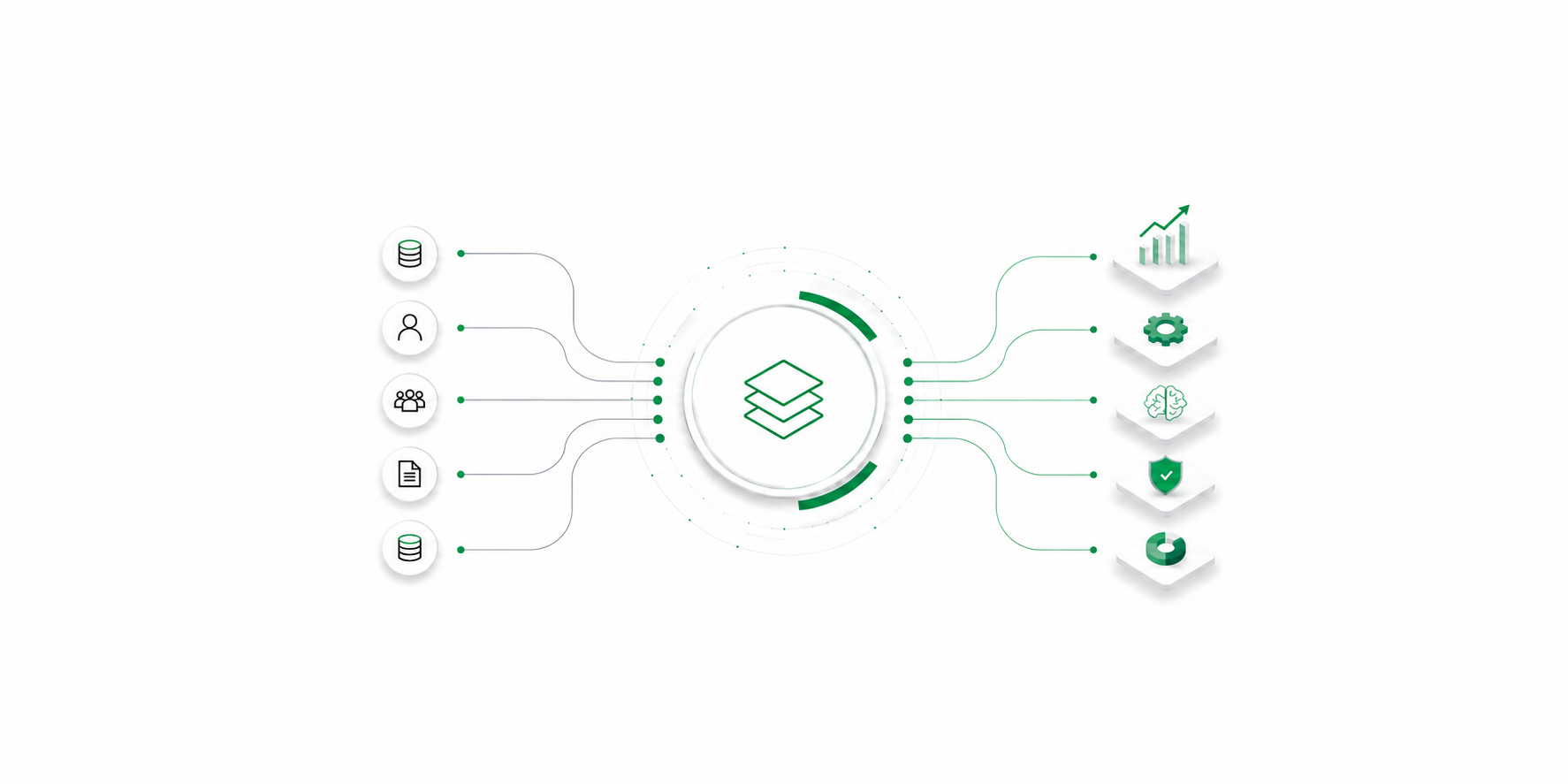
The first pillar is data integration. Enterprise information typically resides across multiple business applications, databases, cloud services, and legacy systems. Connecting these sources creates a unified view of organizational data, allowing AI applications to work with complete and consistent information rather than isolated datasets.
The second pillar is data governance. As AI becomes more deeply embedded in business operations, organizations must ensure that data remains accurate, secure, compliant, and properly managed throughout its lifecycle. Strong governance improves trust in AI-generated insights while supporting regulatory and security requirements.
A modern AI foundation also depends on document intelligence. Large volumes of valuable business knowledge exist in contracts, invoices, reports, emails, PDFs, and other unstructured documents. Extracting and structuring this information allows AI systems to understand and utilize knowledge that was previously inaccessible to traditional applications.
Finally, knowledge management connects structured and unstructured information into a searchable, organization-wide knowledge base. Instead of searching across disconnected systems, employees and AI applications can access trusted business knowledge from a unified source, improving productivity, collaboration, and decision-making.
Organizations that invest in these foundational capabilities create an environment where Enterprise AI can scale securely, generate reliable insights, and deliver measurable business outcomes across the enterprise.
Data Integration
Data integration is the foundation of every successful Enterprise AI initiative. Organizations generate data across ERP, CRM, HR, finance, supply chain, cloud applications, and countless other systems. When these systems operate independently, information becomes fragmented, making it difficult to establish a complete and trusted view of the business.
An effective data integration strategy connects these disparate sources into a unified data ecosystem without disrupting existing operations. By enabling secure and consistent access to enterprise data, organizations reduce duplication, improve data quality, and ensure that business users and AI applications work from the same trusted information.
Beyond supporting analytics, integrated data enables AI to understand relationships across business processes rather than isolated transactions. This broader context improves the accuracy of AI-generated insights, strengthens automation, and allows organizations to make faster, more informed decisions based on real-time enterprise information.
As Enterprise AI continues to evolve, data integration is no longer viewed solely as an IT capability. It has become a strategic business function that enables scalability, operational efficiency, and long-term digital transformation.
Data Governance
As Enterprise AI becomes more deeply integrated into business operations, the quality of AI outcomes depends not only on the availability of data but also on how that data is managed. Without clear governance, organizations risk inconsistent information, compliance issues, security vulnerabilities, and reduced confidence in AI-generated insights.
Data governance establishes the policies, standards, and responsibilities that ensure enterprise data remains accurate, consistent, secure, and accessible throughout its lifecycle. It defines who owns the data, who can access it, how it is protected, and how its quality is maintained across different business systems.
Strong governance also supports regulatory compliance by helping organizations manage sensitive information responsibly while maintaining transparency and accountability. This becomes increasingly important as AI systems process larger volumes of customer, financial, operational, and business-critical data.
Rather than slowing innovation, effective data governance enables it. When enterprise data is trusted and well-managed, organizations can deploy AI solutions with greater confidence, improve collaboration across departments, reduce operational risk, and ensure that AI-driven decisions are based on reliable and well-governed information.
Document Intelligence
A significant portion of enterprise knowledge exists outside traditional databases. Contracts, invoices, reports, emails, forms, PDFs, and other business documents contain valuable information, but much of it remains inaccessible to conventional applications because it is stored as unstructured or semi-structured content.
Document Intelligence bridges this gap by transforming business documents into structured, searchable, and actionable data. Using AI technologies such as optical character recognition (OCR), natural language processing (NLP), and machine learning, organizations can automatically extract key information, classify documents, identify relationships, and integrate document-based knowledge into business workflows.
This capability reduces manual processing, improves data accuracy, and accelerates operations that previously relied on time-consuming document reviews. More importantly, it allows Enterprise AI to access business knowledge that would otherwise remain isolated within documents, enabling more informed decision-making and intelligent automation.
As organizations continue to generate increasing volumes of digital content, Document Intelligence is becoming an essential component of the Enterprise AI foundation. By converting unstructured information into trusted business data, enterprises unlock new opportunities for efficiency, compliance, and AI-driven innovation.
Knowledge Management
Enterprise knowledge is often distributed across multiple repositories, including databases, document management systems, collaboration platforms, intranets, emails, and shared drives. While this information is valuable, employees and AI applications frequently struggle to locate the right knowledge at the right time because it is scattered across disconnected sources.
Knowledge Management addresses this challenge by organizing, connecting, and maintaining business knowledge in a structured and accessible way. Instead of relying on isolated documents or individual expertise, organizations create a centralized knowledge ecosystem where information can be easily discovered, shared, and reused across departments.
For Enterprise AI, effective Knowledge Management provides the business context needed to generate more accurate and relevant responses. AI systems can retrieve trusted organizational knowledge, reduce reliance on incomplete information, and support employees with consistent, up-to-date insights. This not only improves decision-making but also accelerates onboarding, enhances collaboration, and preserves institutional knowledge as organizations grow.
As AI adoption expands, Knowledge Management is evolving from a productivity initiative into a strategic capability. Organizations that establish a trusted knowledge foundation enable both employees and AI systems to access the right information quickly, supporting more informed decisions and long-term business agility.
How AI Agents Depend on Connected Enterprise Data
AI agents are transforming the way organizations automate workflows, support employees, and interact with customers. Unlike traditional AI models that generate responses from a single prompt, AI agents can reason through tasks, retrieve information from multiple systems, and take actions across business applications. Their effectiveness, however, depends on the quality and accessibility of enterprise data.
An AI agent is only as capable as the information it can access. If enterprise data is fragmented across disconnected systems, the agent operates with an incomplete understanding of the business, leading to inaccurate recommendations, inconsistent actions, and limited automation. Connected data provides the context AI agents need to understand customer relationships, business processes, operational status, and organizational knowledge in real time.
When enterprise systems are integrated, AI agents can retrieve trusted information, coordinate tasks across departments, and support employees with accurate, context-aware insights. Instead of functioning as isolated assistants, they become intelligent participants in business workflows, helping organizations improve efficiency, reduce manual effort, and accelerate decision-making.
As Enterprise AI continues to evolve, the success of AI agents will depend less on increasingly powerful models and more on the availability of connected, governed, and business-ready data. Organizations that establish this foundation enable AI agents to operate with greater accuracy, reliability, and measurable business impact.
Executive Analytics: Turning Data into Decisions
Collecting enterprise data is only the first step. The real business value emerges when data is transformed into actionable insights that support strategic and operational decision-making. Executive Analytics enables business leaders to monitor performance, identify trends, evaluate risks, and make informed decisions based on reliable, real-time information.
Unlike traditional reporting, modern executive analytics consolidates data from multiple business systems into a unified view of the organization. By combining financial, operational, customer, and workforce data, executives gain a comprehensive understanding of business performance without relying on fragmented reports from individual departments.
Enterprise AI further enhances this process by identifying patterns, detecting anomalies, generating predictive insights, and presenting complex information in a way that is easier to understand and act upon. Rather than spending time gathering and validating data, decision-makers can focus on evaluating opportunities, responding to challenges, and defining business strategy.
As organizations become increasingly data-driven, Executive Analytics is evolving from a reporting function into a strategic capability. When supported by integrated, trusted, and well-governed data, it enables faster decisions, greater organizational transparency, and more effective business leadership.
A Practical Roadmap for Enterprise AI Adoption
Successful Enterprise AI adoption requires more than selecting a model or launching isolated pilot projects. Organizations need a structured roadmap that connects AI investment to business priorities, prepares enterprise data, establishes governance, and creates a clear path from experimentation to measurable business value.
The first step is to identify high-value business problems rather than beginning with a specific technology. Organizations should prioritize use cases based on expected impact, data availability, implementation complexity, security requirements, and their ability to support broader strategic goals.
The next step is to assess the existing data and technology environment. This includes identifying fragmented systems, evaluating data quality, defining integration requirements, and determining whether the organization has the infrastructure needed to deploy AI securely. Gaps in data governance, access control, document processing, and knowledge management should be addressed before AI is expanded into critical workflows.
Organizations should then begin with a focused pilot that has clear objectives and measurable success criteria. A pilot can validate technical feasibility, reveal operational risks, and demonstrate business value without requiring an immediate enterprise-wide deployment. However, it should be designed with future integration and scalability in mind rather than treated as an isolated experiment.
Once a use case proves valuable, the organization can gradually scale it across departments and workflows. This stage requires standardized architecture, continuous monitoring, employee training, change management, and clear accountability for AI performance and risk.
Enterprise AI adoption is therefore an ongoing transformation rather than a one-time implementation. Organizations that move through a deliberate sequence of strategy, readiness, experimentation, governance, and scaling are better positioned to turn AI initiatives into secure, sustainable, and measurable business capabilities.
Conclusion
Enterprise AI is not built on larger language models alone. Its success depends on the quality, accessibility, and governance of the data that powers every AI application. Organizations that invest only in AI models without addressing fragmented data, disconnected systems, and inconsistent governance often struggle to move beyond isolated experiments.
A strong Enterprise AI foundation begins with integrated data, effective governance, intelligent document processing, and well-managed organizational knowledge. These capabilities enable AI agents to operate with business context, support executive decision-making, and deliver measurable value across the enterprise.
As AI adoption accelerates, competitive advantage will increasingly come from how well organizations connect, manage, and activate their enterprise data. Businesses that establish this foundation today will be better prepared to deploy secure, scalable, and business-ready AI solutions that create long-term operational and strategic value.
Frequently Asked Questions
1. What is Enterprise AI?
Enterprise AI refers to the use of artificial intelligence across an organization's business processes, systems, and data to improve decision-making, automate workflows, and enhance operational efficiency. Unlike consumer AI applications, Enterprise AI focuses on security, scalability, governance, and integration with existing enterprise systems.
2. Why is data integration important for Enterprise AI?
AI systems rely on accurate and connected data to generate reliable insights. When enterprise data is fragmented across multiple applications, AI models lack the business context needed to deliver meaningful results. Data integration creates a unified information foundation that enables AI to perform more effectively.
3. What is the difference between Enterprise AI and Generative AI?
Generative AI focuses on creating new content such as text, images, code, or audio. Enterprise AI is a broader strategy that combines AI technologies with enterprise data, governance, business processes, and system integration to solve real business problems at scale.
4. How do AI agents support Enterprise AI?
AI agents can retrieve information, reason through tasks, and interact with multiple enterprise systems. Their effectiveness depends on access to trusted, connected, and well-governed enterprise data, allowing them to automate workflows and support better business decisions.
5. What are the key components of a successful Enterprise AI strategy?
A strong Enterprise AI strategy typically includes:
- Data Integration
- Data Governance
- Document Intelligence
- Knowledge Management
- AI Agents Executive
- Analytics Secure and scalable AI infrastructure
Together, these components provide the foundation required for reliable, business-ready AI solutions.
Sources
- IBM – Data Quality
- McKinsey & Company – The State of AI
- Microsoft – What is Knowledge Management?
- Google Cloud – AI Agents