
Enterprise AI is moving from experimentation into everyday business operations. AI systems now analyze internal data, support decisions, interact with enterprise applications, and increasingly take action through AI agents.
As AI connects to enterprise data, APIs, applications, and operational workflows, governance increasingly becomes an architectural concern involving identity, access control, observability, and runtime boundaries.
As AI becomes embedded in business processes, a more difficult question emerges: How do organizations ensure that these systems remain secure, accountable, transparent, and aligned with business and regulatory requirements?
From AI Adoption to AI Accountability
Generative AI and AI agents are expanding the role of AI inside organizations. Modern systems can retrieve enterprise knowledge, call tools, interact with applications, and increasingly execute multi-step workflows.
That means AI risk is no longer limited to model accuracy. Data access, security, human oversight, operational behavior, and regulatory obligations now intersect throughout the AI lifecycle.
This broader view is reflected in major governance frameworks. NIST treats AI risk management as a continuous process across the lifecycle, while ISO/IEC 42001 approaches AI governance as an organizational management system that must be maintained and continually improved.
For enterprises, AI governance is therefore becoming less of a compliance exercise and more of an operating capability.
This governance layer depends on something even more fundamental: trusted and connected enterprise data. We explored that foundation in The Data Integration Problem No AI Model Can Solve.
AI Governance Must Follow the System, Not Just the Model
Traditional model governance focused heavily on development: training data, model validation, performance metrics, and approval before deployment.
Enterprise AI has expanded that boundary. An AI system may retrieve internal documents, access business data, call external tools, trigger workflows, or act through an AI Agent. Governance therefore has to cover not only the model, but the environment in which AI operates.
A useful way to think about this is to govern four connected layers: who is responsible for the AI, what information it can use, what actions it is allowed to take, and what evidence remains after those actions occur.
The Enterprise AI Control Surface
Trust emerges when governance connects responsibility, data, actions, and evidence.
This risk-based approach is also reflected in Microsoft's guidance for governing AI agents.
AI Governance Across the AI Lifecycle
Trustworthy AI is not created at a single approval gate. It has to survive every stage of the AI lifecycle.
A system may begin with well-defined policies and still become risky after deployment. Data sources change, business context evolves, models are updated, user behavior shifts, and AI agents may gain access to new tools or workflows.
This is why effective AI governance needs continuous visibility. Organizations need to know what an AI system is designed to do, what data it depends on, how it performs in production, and whether its behavior remains within acceptable boundaries.
In practice, governance becomes a feedback loop: define expectations, observe real behavior, detect change, and intervene when necessary.
A Continuous Governance Loop
1. DEFINE
Purpose
Ownership
Policies
Risk tolerance
2. OBSERVE
Data
Outputs
Actions
Performance
3. DETECT
Drift
Anomalies
Policy violations
Emerging risks
4. RESPOND
Human intervention
Restriction
Correction
Improvement
This continuous approach closely aligns with the NIST AI Risk Management Framework, where Govern, Map, Measure, and Manage operate across the AI system lifecycle rather than as a one-time checklist.
But continuous monitoring solves only part of the problem. Before an organization can govern AI behavior, it must first know what AI systems actually exist across the enterprise.AI systems now analyze internal data, support decisions, interact with enterprise applications, and increasingly take action through AI agents.
AI Governance Starts With Visibility
AI governance starts with visibility.
As AI adoption spreads across business units, the enterprise AI landscape becomes harder to map. A single organization may now use internally developed models, third-party AI services, embedded AI features, autonomous agents, and employee-adopted tools that were never formally reviewed.
This creates a governance blind spot. An organization cannot reliably assign ownership, assess risk, enforce policies, or investigate incidents if it does not know which AI systems are operating, what they connect to, and how they are being used.
The inventory, however, needs to extend beyond traditional machine-learning models. Modern governance must account for the wider AI ecosystem surrounding them.
| Governance Question | What to Track | AI Asset |
|---|---|---|
| Which model is making the decision? | Version, owner, purpose | Models |
| What can the agent actually do? | Identity, tools, permissions | AI Agents |
| What information can AI use? | Origin, sensitivity, access | Data Sources |
| What risk exists outside our control? | Provider, dependency, terms | Third-party AI |
| Where does AI affect the business? | Business process, users, impact | AI Use Cases |
The Hidden Layer: Shadow AI
The harder problem is the AI that never entered the inventory.
Shadow AI appears when employees or teams use AI tools, agents, models, or integrations outside formal governance processes. What may begin as a productivity shortcut can create unknown data flows, unmanaged permissions, security exposure, and accountability gaps.
The rise of AI agents makes this visibility problem more significant. Unlike a standalone chatbot, an agent may have an identity, access enterprise data, connect to tools, and execute actions across business systems.
The first governance question is therefore not "Is our AI compliant?" It is more fundamental: "Do we know where our AI is?"
AI Governance Starts With the Data
AI can only be governed effectively when the data behind it is governed too.
Enterprise AI does not operate on models alone. It retrieves documents, queries databases, uses business context, connects to applications, and increasingly allows AI agents to act on enterprise information.
This creates a direct connection between AI governance and data governance. If an organization cannot determine where data came from, who can access it, how sensitive it is, or whether it is still reliable, governing the AI system that uses that data becomes significantly harder.
The goal is not simply to give AI more data. It is to give AI the right data, with the right context, under the right controls.
- Ensure data quality. AI systems need accurate, consistent, and current information. Poor-quality enterprise data can produce unreliable outputs even when the underlying model performs well.
- Preserve business context. Data without meaning is not enough. Metadata, business definitions, relationships, and organizational context help AI interpret information correctly rather than simply retrieve it.
- Control access to sensitive information. AI should not automatically inherit access to every connected data source. Permissions, sensitivity classifications, and usage policies determine what information a model or AI agent is allowed to use.
- Maintain traceability. Organizations need to understand where information came from, how it was transformed, and which data contributed to an AI-driven decision. Data lineage becomes especially important when outputs need to be investigated or audited.
- Govern data at the point of action. As AI agents move from generating answers to executing workflows, data governance also becomes an operational control—helping determine what information an agent can access while taking action.
Google Cloud similarly positions data governance as a foundation for making enterprise data secure, trustworthy, discoverable, and usable for AI.
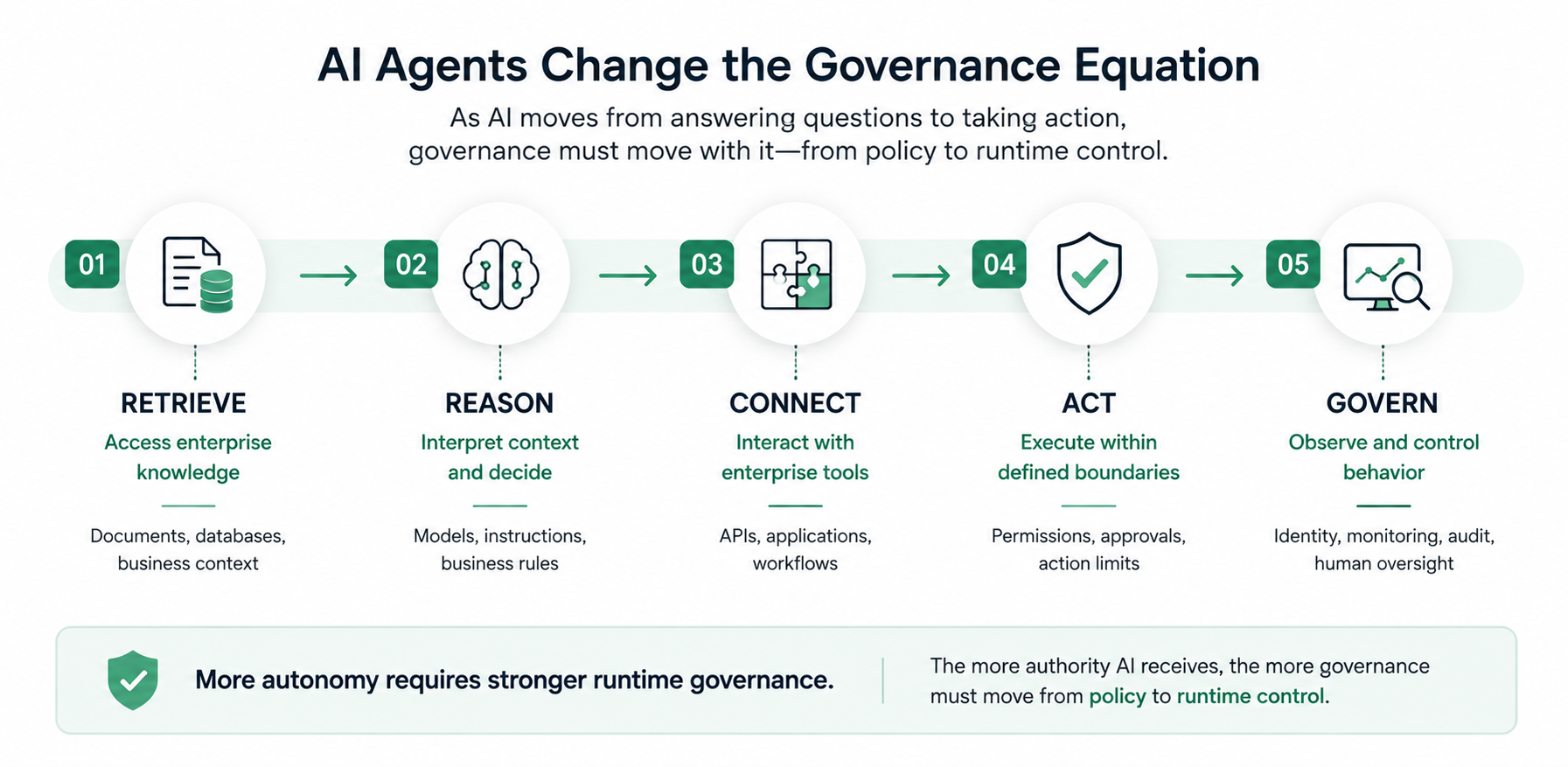
AI Agents Change the Governance Equation
AI agents introduce a new governance challenge because they can do more than generate answers. They can retrieve enterprise information, use tools, interact with applications, and increasingly execute actions across business workflows.
This changes what organizations need to govern. The question is no longer only what an AI system knows or generates, but what it is allowed to do. Identity, permissions, tool access, data boundaries, human oversight, and runtime monitoring become part of the governance architecture.
The level of control should also reflect the level of autonomy. An assistant that summarizes an internal document does not carry the same risk as an agent that modifies customer records, initiates transactions, or triggers operational workflows.
Effective AI governance therefore does not mean placing a human approval step in front of every action. It means defining where AI can operate independently, where additional controls are required, and where human judgment must remain in the loop.
As AI moves from answering questions to taking action, governance must move with it—from policy on paper to control at runtime.
How to Start AI Governance Without Slowing Down AI
AI governance does not need to begin with a large compliance program. In many organizations, the better starting point is visibility: understand where AI is already being used, which business processes it affects, what data it can access, and who is responsible for it.
From there, governance can be applied according to risk. An internal assistant that summarizes approved documents may require relatively lightweight controls, while an AI agent that accesses sensitive data or executes business actions needs stronger oversight, permissions, and monitoring.
The goal is to create clear guardrails without turning every AI initiative into a lengthy approval process. Policies should define what is acceptable, technical controls should enforce critical boundaries, and monitoring should reveal when real-world behavior begins to move outside those boundaries.
This is where effective AI governance becomes an enabler rather than a blocker. When teams know the boundaries in advance, they can experiment and deploy AI with greater confidence instead of resolving governance questions after something goes wrong.
Conclusion — Trust Is Becoming Infrastructure
AI governance is no longer only about policies, compliance, or model approval. As AI becomes connected to enterprise data, applications, workflows, and increasingly autonomous agents, governance becomes part of the infrastructure that allows AI to operate safely at scale.
The organizations that move fastest will not necessarily be those with the fewest controls. They will be those that know where AI is operating, what data it can access, what actions it can take, who is accountable, and how its behavior is monitored over time.
This is why trust is becoming infrastructure. It must be built into data, access, workflows, monitoring, and accountability—not added after an AI system reaches production.
Frequently Asked Questions About AI Governance
What is AI Governance?
AI governance is the system of policies, responsibilities, technical controls, and monitoring practices used to ensure that AI systems operate safely, transparently, and in alignment with business and regulatory requirements.
Why is AI Governance important for enterprises?
Enterprise AI increasingly interacts with sensitive data, business applications, employees, customers, and operational workflows. Governance helps organizations manage these risks while creating the trust and accountability needed to scale AI responsibly.
What is the difference between AI Governance and Data Governance?
Data governance focuses on the quality, ownership, security, access, and lifecycle of data. AI governance extends beyond data to include models, AI Agents, decisions, actions, human oversight, risk management, and system behavior. The two are closely connected because trustworthy AI depends on trustworthy and well-governed data.
How does AI Governance apply to AI Agents?
AI agents require additional governance because they can interact with tools and business systems and may take actions rather than simply generate responses. Organizations need clear controls around agent identity, permissions, data access, action boundaries, human oversight, monitoring, and accountability.
Does AI Governance slow down innovation?
Poorly designed governance can create unnecessary friction. Effective AI governance does the opposite: it establishes clear boundaries before deployment, allowing teams to understand which use cases can move quickly and which require stronger controls because of their risk or impact.